|
"The
Future of Energy is Net Zero
Energy!"
"Net Zero Energy"
to Reach Revenues of $690 Billion / year by 2020
Austin, Texas marketing@UtilitySolarPower.com
|
|
"The
Future of Energy is Net Zero
Energy!"
"Net Zero Energy"
to Reach Revenues of $690 Billion / year by 2020
Austin, Texas marketing@UtilitySolarPower.com
|
Utility Solar Power
www.UtilitySolarPower.com
Utility Solar Power Engineering & Project Development
What is Utility
Solar Power?
Utility Solar Power or utility scale solar power is a method of generating renewable power using only the sun's energy, which is captured and converted into power at solar power parks.
Solar power parks are comprised of one of three types of solar energy technologies: 1. parabolic trough systems 2. solar dish engine systems and 3. solar power towers.
These solar power technologies are used in concentrating solar power plants that use different kinds of mirror configurations to convert the sun's energy into high-temperature heat. The heat energy is then used to generate electricity in a steam generator.
"The Future of Energy is Net Zero Energy!" sm
Think Beyond Solar sm
Architecture * Battery Energy Storage * Bidirectional Inverters * Bidirectional Power
Energy Efficiency Measures * Energy Master Planning * Energy Storage * Micro-Grids
Net Zero Energy * Net Zero Energy Retrofit * Solar Cogeneration * Solar Trigeneration
Homeowners, Business Owners and Commercial Building Owners;
Install our Net Zero Energy System
sm
and
ZERO out your energy bill from your electric utility!
* Zero up-front
cost for most homeowners and businesses in California
* Replace the
"brown power" from central power plants and generate your own clean
power and renewable energy that your home or business needs with our Net Zero
Energy System
sm
* YOU OWN the Net Zero Energy System sm from Day 1,
not some other company.
* This is NOT a "Solar
Lease" scheme or a "Power Purchase Agreement (PPA)."
* YOU own ALL of the benefits of YOUR Net Zero Energy System sm from Day 1, including;
30% Investment Tax Credit
5 year Accelerated Depreciation
* Free Power and Energy
What
is "Net Zero Energy?"
Net Zero Energy - when applied to a home or commercial building, simply means that they generate as much power and energy as they consume, when measured on an annual basis.
Homeowners and Business Owners located in Riverside County and Coachella
Valley
from Ontario to La Quinta and Coachella, and cities in-between,
including; Cathedral City,
Fontana, La Quinta, Ontario, Palm Springs, Rancho Mirage, San
Bernardino, Thousand Palms...
Upgrade your Home or Commercial Building in these cities to "Net
Zero Energy"
and ELIMINATE your monthly energy expenses!
For most
homeowners and business owners (in most areas of California)
we can install a Net Zero Energy System
sm for no up-front cost!
YOU OWN your new Net Zero Energy System sm and ALL of its'
benefits
including Investment Tax Credit, Accelerated Depreciation
and the "Free Power and Energy*" it produces, FROM DAY 1!
*
Free Power and Energy is generated after Net Zero Energy System sm
cost has been paid for.
For most clients, we design the Net Zero Energy system to "zero out"
their monthly electric bills.
This is NOT a
"Solar Lease" SCHEME
or a
"Power Purchase Agreement!"
_______________________________________________
What is a Renewable Energy Credit (REC)?
A Renewable Energy Credit, also referred to as a Renewable Energy Certificate, is a tradable commodity representing one (1) MW (MegaWatt) hour of energy from a renewable energy source such as; solar (including solar hot water), wind, hydro, geothermal, biofuel (Biomethane, B100 Biodiesel and Synthesis Gas or "Syngas") and biomass. One REC represents the environmental attributes and benefits associated with one MWh of electricity generated with renewable energy resources.
A
Renewable Energy
Credit can be sold either "bundled" with the underlying
renewable energy/power (in electrical units; kWhs) or "unbundled"
separately as a separate commodity from the renewable energy (green power)
itself into a separate REC trading market - just like any other commodity.
Each megawatt-hour (MWh) of power generated from renewable resources displaces one MWh of power generated from conventional
sources, most of which burn fossil fuels like coal or natural gas. Using renewable resources reduces emissions of carbon dioxide, particulate
matter and other pollutants.
Note: One MW hour or 1 MWh is also equivalent to 1,000 kWh which also happens to be the average electric consumption for an "average" home over the course of one month.
A Renewable Energy Credit represents the property rights and attributes to the environmental, social, and other non-power qualities of renewable energy electricity generation. A REC, and its associated attributes and benefits, can be sold separately from the underlying physical electricity associated with a renewable-based generation source.
A Renewable Energy Credit provides the purchasers of RECs with flexibility:
In procuring green power across a diverse geographical area.
In applying the renewable attributes to the electricity use at a facility of choice.
This flexibility allows organizations to support renewable energy development and protect the environment when green power products are not locally available.
How do RECs work?
All grid-tied renewable-based electricity generators produce two distinct products:
Physical electricity
RECs
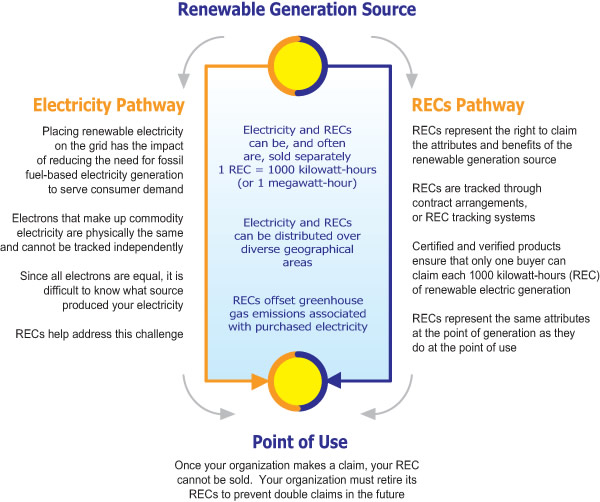
At the point of renewable energy power generation, both product components can be sold together or separately, as a bundled or unbundled product. In either case, the renewable generator feeds the physical electricity onto the electricity grid, where it mixes with electricity from other generation sources. Since electrons from all generation sources are indistinguishable, it is impossible to track the physical electrons from a specific point of generation to a specific point of use.
As renewable generators produce electricity, they create one Renewable Energy Credit for every 1000 kilowatt-hours (or 1 megawatt-hour) of electricity placed on the grid. If the physical electricity and the associated Renewable Energy Credit is sold to separate buyers, the electricity is no longer considered “renewable” or “green.” The REC product is what conveys the attributes and benefits of the renewable electricity, not the electricity itself.
RECs serve the role of laying claim to and accounting for the associated attributes of renewable-based generation. The Renewable Energy Credit and the associated underlying physical electricity take separate pathways to the point of end use (see diagram). As renewable generators produce electricity, they have a positive impact, reducing the need for fossil fuel-based generation sources to meet consumer demand. RECs embody these positive environmental impacts and convey these benefits to the Renewable Energy Credit owner. The following is a list of the inherent primary and derived attributes that a REC can convey to an owner:
|
Primary
Renewable Energy
Credit Attributes |
Secondary
Renewable Energy
Credit Attributes |
|
|
There are two approaches to verifying the ownership of a Renewable Energy Credit and the right to make environmental claims:
REC contracts and an audit of the chain of custody
REC tracking systems
Both of these approaches help buyers avoid double counting and double claims and ensure against fraud. Of the two, Renewable Energy Credit tracking systems provide greater transparency when tracking RECs from their point of creation to their point of final use.
What
is Concentrating
Solar Power?
Concentrating solar power plants produce electric power by converting the sun's energy into high-temperature heat using various mirror configurations. The heat is then channeled through a conventional generator. The plants consist of two parts: one that collects solar energy and converts it to heat, and another that converts heat energy to electricity.
Concentrating solar power systems can be sized for village power (10 kilowatts) or grid-connected applications (up to 100 megawatts). Some systems use thermal storage during cloudy periods or at night. Others can be combined with natural gas and the resulting hybrid power plants provide high-value, dispatchable power. These attributes, along with world record solar-to-electric conversion efficiencies, make concentrating solar power an attractive renewable energy option in the Southwest and other sunbelt regions worldwide.
Why Concentrating Solar
Power is one of the Few "Superior" Renewable Energy Technologies
Concentrating solar power plants use the high annual solar irradiance of the geographic location to generate "carbon free energy" and "pollution free power."
For generating power after the sun sets, many owners/developer of concentrating solar power plants are now installing "Molten Salt Storage" systems that reserves enough energy to allow for electricity generation throughout the nighttime period.
Steam turbines and gas turbines powered by coal, uranium, oil and natural gas are the fuels used today for generating power and electric grid stability. These fuels provide both base-load and peak power. However, these same steam turbines can also be powered by the high temperature heat from concentrating solar power plants.
Concentrating solar power plants in the 30 MW - 200 MW range are now operating successfully in locations from California to Europe. Nearly every day now, new concentrating solar power plants are being planned for construction. The concentrating solar collectors are very efficient and they also completely replace the fossil fuels that were used in traditional power plants. Today's concentrating solar power plants generate the heat needed to generate electricity at a cost equivalent to $50 - $60 per barrel of oil (equivalent). This cost is expected be slashed by 50% to below $25 - $30 per barrel in the next 10 years.
Just like conventional fossil-fueled power plants, concentrating solar power plants generate base-load and peaking power electricity.
Just like fossil fuel fired conventional power plants, concentrating solar power plants have an availability that is close to 100 %, but without the carbon emissions, carbon dioxide emissions, hazardous air pollutants, nitrogen oxides, volatile organic compounds and greenhouse gas emissions that fossil fuel power plants emit.
A
concentrating
solar power plant with a
molten salt storage facility for
full load operation during the nighttime period is currently being built in the Spanish Sierra Nevada near
Guadix.
This concentrating
solar power plant will generate 50 MW of
power.
Another feature that distinguishes concentrating
solar power plants
is the opportunity for combined generation of heat and power - a technology that
is called "Integrated
Solar Combined Cycle" which achieves the highest possible efficiencies for energy conversion. In addition
to power generation, such plants can provide steam for absorption
chillers and/or adsorption
chillers, industrial process heat or thermal ocean water desalination. A design study for such a plant was
completed in 2006. This plant is scheduled to be commissioned in early 2009.
This Integrated Solar
Combined Cycle will provide 10 MW of power, 40 MW of district cooling and 10,000 cubic
meters per day of desalted water for a large hotel in Jordan.
All
the Electricity the World Needs
With Zero Greenhouse
Gas Emissions
from Concentrating
Solar Power Plants
Using a Very Small Part of the Desert
In
the map below, the larger red square on the left shows an area of hot desert
that, if covered with concentrating
solar power plants,
would produce as much electricity as the world currently
uses. The smaller square shows a corresponding area for providing all of the
power needed by the European Union.
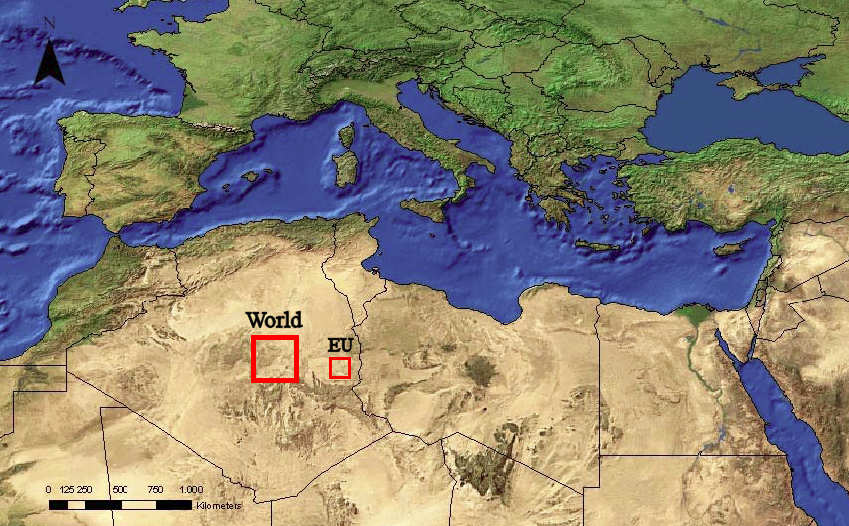
The map and information above courtesy of www.Desertec.org
The Following Press Release Re-printed with
Permission from The World Bank
Over $5.5 billion in New Investment for Clean Energy Technology in the Middle East and North Africa Region
World Bank Press Release No:2010/MNA/183
Washington, DC, December 9, 2009 - The Clean Technology Fund (CTF) approved financing of $750 million on December 2, 2009, which will mobilize an additional $4.85 billion from other sources, to accelerate global deployment of Concentrated Solar Power (CSP). It will do so by investing in the CSP programs of five countries in the Middle East and North Africa: Algeria, Egypt, Jordan, Morocco, and Tunisia. The CTF is a multi-donor trust fund to facilitate deployment of low-carbon technologies at scale. Specifically, the CTF approved an investment plan which will:
Enable MENA to contribute the benefit of its unique geography to global climate change mitigation -- no other region has such a favorable combination of physical and market advantages for
CSP;
Support the deployment of about 1 gigawatt of CSP generation capacity, amounting to a tripling of worldwide CSP capacity;
Support associated transmission infrastructure in the Maghreb and Mashreq for domestic supply and exports, as part of Mediterranean grid enhancement. This will enable the scale up of CSP through market integration in the region;
Leverage public and private investments for CSP power plants, thereby almost tripling current global investments in CSP; and
Support MENA countries to achieve their development goals of energy security, industrial growth and diversification, and regional integration
The proposed gigawatt-scale deployment through 11 commercial-scale power plants over a 3-5 year time-frame would provide the critical mass of investments necessary to attract significant private sector interest, benefit from economies of scale to reduce cost, result in learning in diverse operating conditions, and manage risk.
Shamshad Akhtar, World Bank Regional Vice President of the Middle East and North Africa, said “This is a most strategic and significant initiative for MENA countries. The initiative would leverage energy diversification, while promoting Euro-Mediterranean integration to the benefit of MENA countries that will be able to exploit one of the major untapped sources of energy. This endeavor is far-reaching with global objectives, implications, and potential impact. It will facilitate faster and greater diffusion of this technology in this region which holds significant potential for CSP".
Potential for Green House Gas (GHG) reduction: The proposed projects will avoid about 1.7 million tons of carbon dioxide per year from the energy sectors of the countries. If the program is successful and replicated, the global benefits will be far larger. The transformational objective of this investment plan is served by accelerating cost reduction for a technology that could become least-cost globally, and then be replicated in other countries with high GHG emissions.
Expected Results from the Investment plan: The results indicators for the investment plan are:
§ GHG reductions of at least 1.7 million tons of CO2-equivalent per year.
§ Approximately 900 MW of installed CSP capacity by 2020.
§ $4.85 billion of co-financing mobilized, including sufficient concessional financing to ensure viability of CSP plants.
§ Cost of typical solar field in US$ per m2 is expected to decline over the life of the program.
The Climate Investment Funds (CIF), implemented jointly by the African Development Bank, Asian Development Bank, European Bank for Reconstruction and Development, Inter-American Development Bank, International Finance Corporation, and World Bank, is comprised of the CTF to provide scaled up financing for the demonstration, deployment and transfer of low carbon technologies that have a significant potential for long-term greenhouse gas emissions savings; and the SCF, a suite of three targeted programs to pilot new approaches to climate action, each with potential for scaled up, transformational action: the Pilot Program for Climate Resilience (PPCR), the Forest Investment Program (FIP) and the Program for Scaling Up Renewable Energy in Low Income Countries
(SREP).
Concentrating
Solar Power
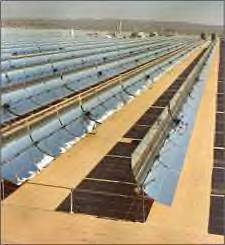
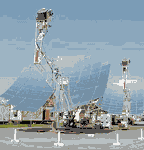
This solar thermal power plant located in the
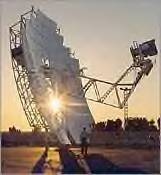
www.SolarDishEngine.com
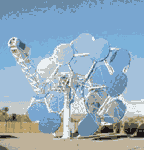
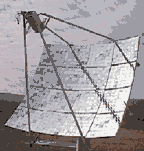
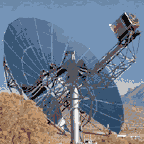
This
solar dish engine is an electric generator that "burns"
sunlight instead of gas or coal to produce electricity. The solar
dish engine (above) is a solar "concentrator" and is the primary solar component of the
system. The solar dish engine collects sunlight and
concentrates the sunlight on a small area. A thermal receiver absorbs the
concentrated beam of solar energy, converts it to heat, and
transfers the heat to the engine/generator.
The
U.S. Department of Energy (DOE) is actively involved in the
research of Concentrating
Solar Power
(CSP). This research and development (R&D) focuses on
three types of concentrating
solar power
technologies: parabolic
trough systems, solar
dish engine
systems and solar
power towers. These technologies are used in concentrating solar power
plants that use different kinds of mirror configurations to
convert the sun's energy into high-temperature heat. The heat
energy is then used to generate electricity in a steam generator.
Concentrating
solar power plant's relatively low cost and ability to deliver
power during periods of peak demand - when and where we need
it - means that concentrating solar power can be a major
contributor to the nation's future needs for distributed sources
of "carbon free energy" and "pollution free
power."
DOE's Solar Energy Technologies Program works in concentrating solar power R&D to provide clean, reliable, affordable solar thermal electricity for the nation. The program's goal is to ensure that solar thermal technologies like concentrating solar power make an important contribution to the world's growing need for "carbon free energy" and "pollution free power."
Technology
Overview
Concentrating
solar power plants produce electric power by converting the sun's energy
into high-temperature heat using various mirror configurations. The heat
is then channeled through a conventional generator. The plants consist
of two parts: one that collects solar energy and converts it to heat,
and another that converts heat energy to electricity.
Concentrating solar power systems can be sized for village power (10 kilowatts) or grid-connected applications (up to 100 megawatts). Some systems use thermal storage during cloudy periods or at night. Others can be combined with natural gas and the resulting hybrid power plants provide high-value, dispatchable power. These attributes, along with world record solar-to-electric conversion efficiencies, make concentrating solar power an attractive renewable energy option in the Southwest and other sunbelt regions worldwide.
The
Solar Resource
The solar
resource for generating power from concentrating solar power systems is
plentiful. For instance, enough electric power for the entire country
could be generated by covering about 9 percent of Nevada—a plot of
land 100 miles on a side—with parabolic trough systems.
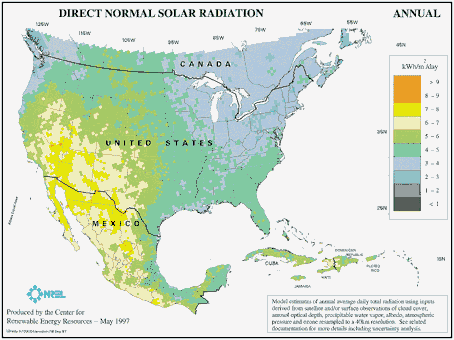
The solar resources for generating power from concentrating solar power systems is plentiful. For instance, enough electric power for the entire country could be generated by covering about 9 percent of Nevada – a plot of land 100 miles on a side – with parabolic trough systems.
The amount of power generated by a concentrating solar power plant depends on the amount of direct sunlight. Like concentrating photovoltaic concentrators, these technologies use only direct-beam sunlight, rather than diffuse solar radiation.
The southwestern United States potentially offers the best development opportunity for concentrating solar power technologies in the world. There is a strong correlation between electric power demand and the solar resource due largely to air conditioning loads in the region. In fact, the Solar Electric Generating System plants operate for nearly 100% of the on-peak hours of Southern California Edison.
How
Does It Work?
There are
three kinds of concentrating solar power systems—troughs,
dish/engines, and power towers—that are classified by how they collect
solar energy.
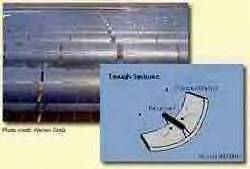 Parabolic
Trough
systems:
Parabolic
Trough
systems:
The sun's energy is concentrated by parabolic (curved) trough-shaped
reflectors onto a receiver pipe running along the inside of the curved
surface. This energy heats an oil that flows through the pipe. The heat
energy is then pumped to a location where the heat energy is converted
to steam and the stem then generates electricity through one or more
steam turbines.
A collector field comprises many troughs in parallel rows aligned on a north-south axis. This configuration enables the single-axis troughs to track the sun from east to west during the day to ensure that the sun is continuously focused on the receiver pipes. Individual Parabolic Trough systems currently can generate about 80 megawatts of electricity.
Parabolic Trough designs can incorporate thermal storage - setting aside the heat transfer fluid in its hot phase - allowing for electricity generation several hours into the evening. Currently, all parabolic trough plants are "hybrids," meaning they use fossil fuel to supplement the solar output during periods of low solar radiation. Typically a natural gas-fired heat or a gas steam boiler/reheater is used; troughs also can be integrated with existing coal-fired plants.
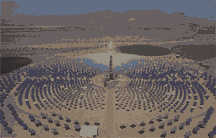
Solar
Power Tower systems:
What is a Solar Power Tower and How Does it Work?
A power tower converts sunshine into clean electricity for the world’s
electricity grids. The technology utilizes many large, sun-tracking
mirrors (heliostats) to focus sunlight on a receiver at the top of a
tower. A heat transfer fluid heated in the receiver is used to generate
steam, which, in turn, is used in a conventional turbine-generator to
produce electricity. Early power towers (such as the Solar One plant)
utilized steam as the heat transfer fluid; current designs (including
Solar Two, pictured) utilize molten nitrate salt because of its superior
heat transfer and energy storage capabilities. Individual commercial
plants will be sized to produce anywhere from 50 to 200 MW of
electricity.
What are the Benefits of Solar Power Towers?
Solar power towers offer large-scale, distributed solutions to our
nation’s energy needs, particularly for peaking power. Like all solar
technologies, they are fueled by sunshine and do not release greenhouse
gases. They are unique among solar electric technologies in their
ability to efficiently store solar energy and dispatch electricity to
the grid when needed — even at night or during cloudy weather. A
single 100-megawatt power tower with 12 hours of storage needs only 1000
acres of otherwise non-productive land to supply enough electricity for
50,000 homes. Throughout the sunny Southwest, millions of acres are
available with solar resources that could easily produce solar power at
the scale of hydropower in the Northwest U. S.
What is the Status of Power Tower Technology?
Power towers enjoy the benefits of two successful, large-scale
demonstration plants. The 10-MW Solar One plant near Barstow, CA,
demonstrated the viability of power towers, producing over 38 million
kilowatt-hours of electricity during its operation from 1982 to 1988.
The Solar Two plant was a retrofit of Solar One to demonstrate the
advantages of molten salt for heat transfer and thermal storage.
Utilizing its highly efficient molten-salt energy storage system, Solar
Two successfully demonstrated efficient collection of solar energy and
dispatch of electricity, including the ability to routinely produce
electricity during cloudy weather and at night. In one demonstration, it
delivered power to the grid 24 hours per day for nearly 7 straight days
before cloudy weather interrupted operation.
The successful conclusion of Solar Two sparked worldwide interest in
power towers. As Solar Two completed operations, an international
consortium, led by the U. S. (with
technical support from Sandia National Laboratories), formed to pursue
power tower plants worldwide, especially in Spain (where special solar
premiums make the technology cost-effective), but also in Egypt,
Morocco, and Italy. Their first commercial power tower plant is planned
to be four times the size of Solar Two (about 40 MW equivalent,
utilizing storage to power a 15MW turbine up to 24 hours per day).
This industry is also actively pursuing opportunities to build a similar
plant in our desert Southwest, where a 30 to 50 MW plant would take
advantage of the Spanish design and production capacity to reduce costs,
while providing much needed peaking capacity for the Western grid. The
first such plant would cost in the range of $100M and produce power for
about 15¢/kWh. While still somewhat higher in cost than conventional
technologies in the peaking market, the cost differential could be made
up with modest green power subsidies and political support,
jump-starting this technology on a path to 7¢/kWh power with the
economies of scale and engineering improvements of the first few plants.
It would, at that point, provide clean power as economically as more
conventional technologies.
|
|
|
This
Solar Dish
Engine
project will evaluate the
performance of the “critical” parts of the Stirling engine. |
Solar
Dish Engines
What
is a Solar Dish-Engine System?
A Solar Dish Engine is an electric generator that “burns”
sunlight instead of gas or coal to produce electricity. The major parts
of a system are the solar concentrator and the power conversion unit.
Descriptions of these subsystems and how they operate are presented
below.
The dish, which is more specifically referred to as a concentrator, is the primary solar component of the system. It collects the solar energy coming directly from the sun (the solar energy that causes you to cast a shadow) and concentrates or focuses it on a small area. The resultant solar beam has all of the power of the sunlight hitting the dish but is concentrated in a small area so that it can be more efficiently used. Glass mirrors reflect ~92% of the sunlight that hits them, are relatively inexpensive, can be cleaned, and last a long time in the outdoor environment, making them an excellent choice for the reflective surface of a solar concentrator. The dish structure must track the sun continuously to reflect the beam into the thermal receiver.
The power conversion unit includes the thermal receiver and the engine/generator. The thermal receiver is the interface between the dish and the engine/generator. It absorbs the concentrated beam of solar energy, converts it to heat, and transfers the heat to the engine/generator. A thermal receiver can be a bank of tubes with a cooling fluid, usually hydrogen or helium, which is the heat transfer medium and also the working fluid for an engine. Alternate thermal receivers are heat pipes wherein the boiling and condensing of an intermediate fluid is used to transfer the heat to the engine.
|
|
|
This 25
kW Solar Dish
Engine
is operating at in the Southwest U.S. |
The engine/generator system is the subsystem that takes the heat from the thermal receiver and uses it to produce electricity. The most common type of heat engine used in dish-engine systems is the Stirling engine. A Stirling engine uses heat provided from an external source (like the sun) to move pistons and make mechanical power, similar to the internal combustion engine in your car. The mechanical work, in the form of the rotation of the engine’s crankshaft, is used to drive a generator and produce electrical power.
In addition to the Stirling engine, concentrating photovoltaic technologies are also being evaluated as possible future power conversion unit technologies. A photovoltaic conversion system is not actually an engine, but a semi-conductor array, in which the sunlight is directly converted into electricity.
|
|
|
Small Solar Dish Engine system. |
What
are the markets for Solar Dish-Engines?
Solar dish engines are being developed for use in emerging global
markets for distributed generation, green power, remote power, and
grid-connected applications. Individual units, ranging in size from 9 to
25 kilowatts, can operate independent of power grids in remote sunny
locations to pump water or to provide electricity for people living in
remote areas. Largely because of their high efficiency and
“conventional” construction, the cost of dish-engine systems is
expected to compete in distributed markets.
|
|
|
This
Solar
Dish Engine
generates |
Opportunities are emerging for the deployment of dish-engine systems in the Southwest U.S. Many states are adopting green power requirements in the form of a “renewable portfolio standard” and other renewable energy mandates. While the potential markets in the U.S. are large, the size of developing worldwide markets is immense. The International Energy Agency projects an increased demand for electrical power worldwide more than doubling installed capacity. More than half of this is in developing countries and a large part is in areas with good solar resources, limited fossil fuel supplies, and no power distribution network. The potential payoff for dish-engine system developers is the opening of these immense global markets for the export of power generation systems.
|
|
|
Experience gained with Solar Two has established a foundation which will lead to the first commercial Concentrating Photovoltaic Power Plant |
Business
and Market Opportunities
With one of the best direct normal insolation resources anywhere on
earth, the southwestern states are poised to reap large and as yet
largely uncaptured economic benefits from this important natural
resource. California, Nevada, Arizona, and New Mexico are each exploring
policies that will nurture the development Concentrated Solar Power
Technologies..
In addition to the concentrating solar power projects under way in this country, a number of projects are being developed in India, Egypt, Morocco, and Mexico. In addition, independent power producers are in the early stages of design and development for potential parabolic trough power projects in Greece (Crete) and Spain. Given successful deployment of one or more of these initial markets, additional project opportunities are expected in these and other regions.
One key competitive advantage of concentrating solar energy systems is their close resemblance to most of the power plants operated by the nation's power industry. Concentrating solar power technologies utilize many of the same technologies and equipment used by conventional central station power plants, simply substituting the concentrated power of the sun for the combustion of fossil fuels to provide the energy for conversion into electricity. This "evolutionary" aspect—as distinguished from "revolutionary" or "disruptive"—results in easy integration into today's central station–based electric utility grid. It also makes concentrating solar power technologies the most cost-effective solar option for the production of large-scale electricity generation.
Analysts predict the opening of specialized niche markets in this country for the solar power industry over the next 5 to 10 years. The U.S. Department of Energy estimates that by 2005 there will be as much as 500 megawatts of concentrating solar power capacity installed worldwide.
What
Does It Cost?
Concentrating
solar power technologies currently offer the lowest-cost solar
electricity for large-scale power generation (10 megawatt-electric and
above). Current technologies cost $2–$3 per watt. This results in a
cost of solar power of 9¢–12¢ per kilowatt-hour. New innovative
hybrid systems that combine large concentrating solar power plants with
conventional natural gas combined cycle or coal plants can reduce costs
to $1.5 per watt and drive the cost of solar power to below 8¢ per
kilowatt hour.
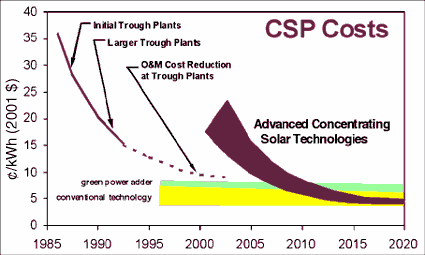
Advancements in the technology and the use of low-cost thermal storage will allow future concentrating solar power plants to operate for more hours during the day and shift solar power generation to evening hours. Future advances are expected to allow solar power to be generated for 4¢–5¢ per kilowatt-hour in the next few decades.
What is Front End Engineering Design?
Front-end
Engineering Design, also known as Front End
Engineering or
"FEED," is the preliminary engineering and conceptual design completed
in advance of the start of EPC (Engineering, Procurement and
Construction). Front End Engineering usually concludes with the
engineering firm's presentation of an Engineering
Feasibility Study or Analysis.
Front-end
Engineering Design includes a design team that includes and integrates
all or most engineering fields such as mechanical engineering, electrical
engineering, environmental engineering, civil engineering, power engineering,
chemical engineering, etc. The FEED design team includes the project
visualization and conceptualization stages, including "what-if"
decision making analyses, integrating the client company's goals, objectives
into an efficient and economic engineering solution.
What is Balance of
Plant?
Balance of plant
or "BOP," consists of the remaining systems, components, and structures that comprise a complete power plant or energy system
- not included in the prime mover and waste heat recovery (ex.
gas turbines,
steam turbines,
heat
recovery steam generators (HRSG), waste heat
boilers, etc.) systems. In solar
power parks, BOP is referred to as BOS or balance
of system.
Engineering Procurement Construction, also referred to as; Engineer Procure Construct, "EPC" or Engineering Procurement and Construction, is the terminology used when an owner, for example, is seeking to build a new cogeneration power plant uses when the owner is seeking a "turnkey" project solution. EPC contracts are not only a very common form of contracting within the construction industry, but increasingly becoming the norm, particularly in the electric power generation (power plants) and utility sector.
The construction company, via the EPC contract with the owner, provides for the design, engineering, procurement of all related supplies, components, materials, labor, services, etc. The contractor, with approval/permit by EPC contract with the owner, may sub-contract part of the work.
Engineering Procurement and Construction or "EPC" contracts with long-term performance guarantees are becoming increasingly popular for some renewable energy technologies, such as commercial-scale Distributed Solar Generation / Distributed PV systems.
Engineering Procurement and Construction contracts give the owner unprecedented assurance that the system will provide the long-term energy benefits advertised without wasting time and money with the Architectural and Engineering ("A&E") firm or expensive change orders that take additional time and resources to process and integrate. These performance guarantees cover the entire installation and go way beyond manufacturer warranties that only cover specific parts and not the system as a whole.
EPC and performance guarantee contracts can be a wise choice for many reasons. Oftentimes, the Architectural and Engineering firms do not have the in-house expertise to understand fully how to specify renewable energy systems. Due to the newer nature of these technologies and the rapidly developing nature of many technologies, this is a specialized field of its own for each renewable technology type. If the Architectural and Engineering company specifies particular equipment, while it may be feasible, it may not be the optimal design or the most likely to be available at construction.
EPC contracts also provide more flexibility in equipment choices that can reduce change orders and construction delays. For example, many photovoltaic modules change specifications and dimensions on almost a monthly basis. Even the oldest and most reputable manufacturers are working to keep pace with fierce competition in the field today. Given that the modules are the heart of the photovoltaic system, it reasons that specifying a particular module in the construction documents might result in a change order and result in cost over runs and delays by actual construction.
In an EPC contract with a performance guarantee, the contractor has a strong financial incentive to use the most reliable and highest performing equipment and to ensure the highest standards are maintained throughout installation and that any details that could influence long-term performance are addressed. Practices ranging from cherry picking the highest output modules to over-sizing wiring and conduit to improved operations and maintenance (O&M) plans might not be necessary for inspection or commissioning but can contribute to meeting the contractor's long-term performance liability. These same practices in turn enhance the long-term energy performance to the greater benefit of the facility and those that operate it.
Performance guarantee contracts attract top renewable energy contractors with long-term success in their fields. Less capable or experienced contractors will not savor the extra liability involved, nor will they have the expertise or even access to the top quality equipment necessary to fulfill a performance guarantee.
Certain provisions should be included with any EPC contract to ensure coordination and consistency with the remainder of the project. All contracts and subcontracts related to the project should include provisions requiring participation in the integrated design process including coordination of design with other related aspects of the project.
The EPC contractor needs to work with the Architectural and Engineering firm to understand the building elements that are necessary to the integration of the renewable energy system. In addition, an EPC contract needs provisions to ensure coordination with the larger project construction team. While coordination is important, this type of design and construction contract allows the contractors to do what they do best and frees more of the agency's critical planning resources for other aspects of the project.
Additional provisions standard with other construction contract terms should also be included in the EPC contract. These include requiring the team to perform enhanced commissioning over the first year and developing an O&M manual and training for the system.
Through a combination of EPC contracts combined with long-term performance guarantees, the construction relationship is transformed from being sometimes adversarial to being a win/win situation for everyone involved.
Engineering Procurement
Construction and
Front End Engineering Design (FEED)
and
Project Development Services
Carbon Dioxide Emissions
Since the year 1750
|
## |
|
World CO2 since 1750 (cubic feet) |
World Carbon Dioxide Emissions since 1750 (cubic feet)
The
carbon clock tracks total carbon dioxide
emissions in metric tons since 1750.
Since 1750, humans have emitted over 5 trillion pounds of carbon
emissions into
the atmosphere. Roughly half of this has ended up in the oceans where it is
beginning to damage the coral reefs. The other half is still in the atmosphere
and causing global warming. Each pound of CO2 takes up as much space as a 500
pound person.
The formula (which should be good for a year or two) is:
C(t) = 2.58 ×10¹² + 1240×t, where t is seconds since the start of 2007.
C is tonnes (metric tons) of carbon dioxide
emissions.
2205 x C gives pounds of carbon dioxide
emissions.
That comes to over 43 billion tons/year or over 86 trillion pounds/year.
Carbon dioxide (2) = 1 carbon atom with 2 oxygen atoms.
Carbon has relative weight 12 and Oxygen 16.
So it takes only 12 pounds of carbon to make 12+16+16 = 44 pounds of CO2.
What is "Decentralized Energy"?
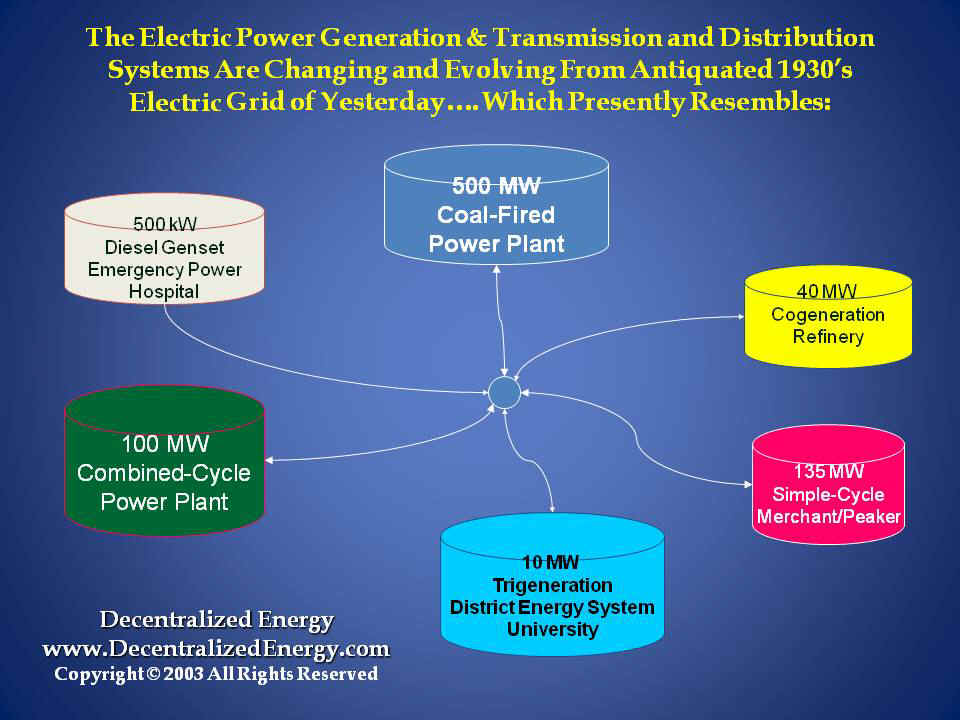
Decentralized Energy is the opposite of "centralized energy." Decentralized Energy energy generates the power and energy that a residential, commercial or industrial customer needs, onsite. Examples of decentralized energy production are solar energy systems and solar trigeneration energy systems.
Today's electric utility industry was "born" in the 1930's, when fossil fuel prices were cheap, and the cost of wheeling the electricity via transmission power lines, was also cheap. "Central" power plants could be located hundreds of miles from the load centers, or cities, where the electricity was needed. These extreme inefficiencies and cheap fossil fuel prices have added a considerable economic and environmental burden to the consumers and the planet.
Centralized energy is found in the form of electric utility companies that generate power from "central" power plants. Central power plants are highly inefficient, averaging only 33% net system efficiency. This means that the power coming to your home or business - including the line losses and transmission inefficiencies of moving the power - has lost 75% to as much as 80% energy it started with at the "central" power plant. These losses and inefficiencies translate into significantly increased energy expenses by the residential and commercial consumers.
Decentralized Energy
is the Best Way to Generate Clean and Green Energy!
How we make and distribute electricity is changing!
The electric power generation, transmission and distribution system (the electric "grid") is changing and evolving from the electric grid of the 19th and 20th centuries, which was inefficient, highly-polluting, very expensive and “dumb.”
The "old" way of generating and distributing energy resembles this slide:
Some customers will choose to
dis-connect from the
grid entirely.
(Electric grid represented by the small light blue circles in the slide below.)
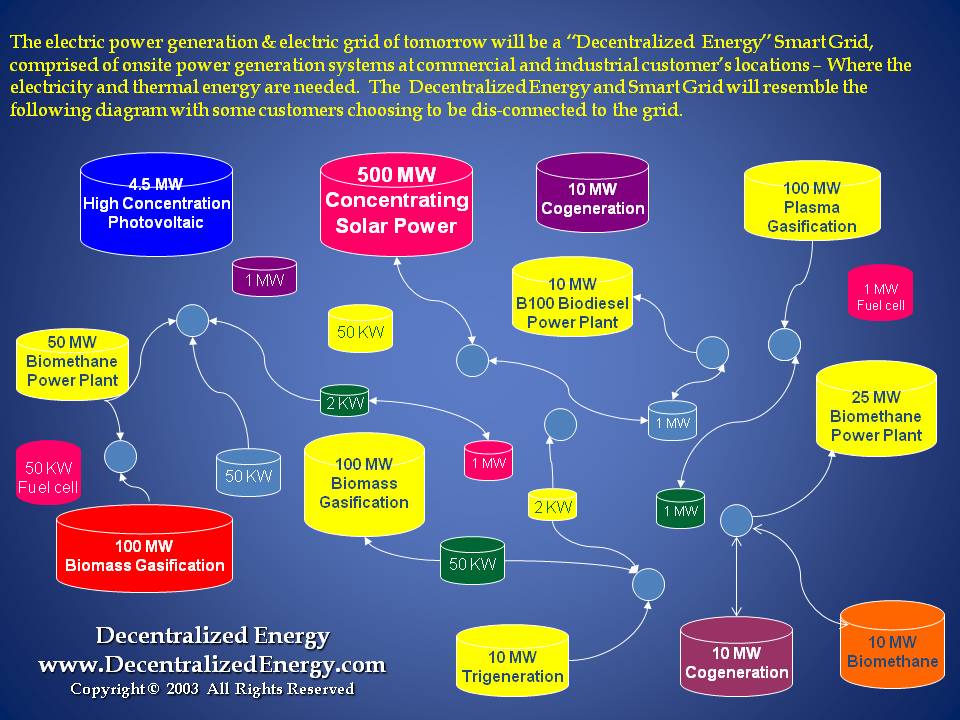
Typical "central" power plants and the electric utility companies that own them will either be shut-down, closed or go out of business due to one or more of the following: failed business model, inordinate expenses related to central power plants that are inefficient, excessive pollution/emissions, high costs, continued reliance on the use of fossil fuels to generate energy, and the failure to provide efficient, carbon free energy and pollution free power.
Carbon free energy and pollution free power reduces our dependence on foreign oil and makes us Energy Independent while reducing and eliminating Greenhouse Gas Emissions.
* Some of the above information from the Department of Energy website with permission.
America's "Clear and Present Danger"
America
Has INCREASED its' Dependence on Foreign
Sources of Energy by 50% Since 1973.
America
is even more "addicted" to foreign oil today, than we were in 1973 -
1974 when OPEC, Saudi Arabia and other suppliers from the Middle-East
stopped selling us their fossil fuels, and created a significant blow to our
economy.
According
to the EIA, the U.S.A.
PRODUCES: 12,170,000 bbls of oil each day
CONSUMES:
20,800,000 bbls of oil each day
EVERY
day, the U.S. must IMPORT over 9 million bbls of oil from foreign
countries and foreign suppliers to meet demand.
This
Means that > 40% of America's Energy Supplies are Now Imported from Suppliers
from Foreign Countries which means that 43%
of the gasoline in your car's gas tank, comes from a foreign country!
At $100/barrel of oil, this also means that $900 million (American) Dollars leave
our country, EVERY DAY, and go to foreign countries/suppliers of our fossil fuels, to
pay for the energy we need.
That's almost $1 Billion dollars EVERY DAY - leaving our economy, and going to support a foreign
country's economy, employ THEIR workers and talk
about our foreign trade deficit..... nearly $300 Billion EVERY year, leaves our
country to pay for our oil addiction and the energy we need. That's about
1/3 of a TRILLION DOLLARS every year!
This is NOT acceptable.
America needs to quickly transition to Energy Independence. American Oil and Natural Gas PLUS American Renewable Energy is the Only Way America Can Achieve Energy Independence.
Millions of new and sustainable American jobs would be created here at home, if we would end our addiction to foreign fossil fuels, and quickly transition to an economy based on renewable energy and renewable fuels, produced here in the U.S.A.
The good news is that today, America already has all of the Renewable Energy Technologies needed to make American Energy Independence a reality.
According to Monty Goodell, Founder and Chairman of the Renewable Energy Institute, "our increased dependence and reliance on foreign energy supplies represents a Clear and Present Danger to our national security, our economy, and the lives and livelihood of every American. Energy - including the energy we use from imported fossil fuels, is the very "lifeblood" of the American economy as it is for every industrialized country. An economy dies without it's lifeblood of energy. This Clear and Present Danger we face is far more serious than the problems related to greenhouse gas emissions. And while greenhouse gas emissions are very serious issue, in the long-term, pales in comparison to America's vital national security interests and America's economic stability in the short term. For this reason alone, America needs to transition away from its addiction to foreign energy supplies. And America's abundant renewable energy resources such as the energy we receive from the sun, and renewable energy technologies such as concentrated solar power (CSP) plants - can supply 100% of America's power requirements with a concentrating solar power plant measuring 75 miles by 75 miles, located in the Southwest U.S. By generating America's power from concentrating solar power plants, America resolves its' short-term Clear and Present Danger as it relates to importing its energy from foreign countries, and the long-term problems relating to greenhouse gas emissions."
Continuing, Mr. Goodell states that "too many Americans have forgotten what happened to us in 1973, when the Arabs and OPEC brought the United States economy to a screeching halt during the OPEC Oil Embargo. This happened because they (mainly the country of Saudi Arabia) disagreed with our foreign policy and is the reason why they "turned off the tap" of our need for their oil supplies. When Saudi Arabia and OPEC stopped the vital flow of oil to our country in 1973, they caused an "oil shock" that severely and negatively impacted our economy.
Mr. Goodell's question for us to ponder is, "do these countries who sell us 60% of our daily energy requirements, like us and our foreign policy, or might they leverage our addiction to their fossil fuels, and turn off the tap to make us adjust or revise our foreign policy?? Like any addict, America's foreign policy may be held hostage to its addiction, and in this case, our addiction to foreign oil, may over-ride our national interests."
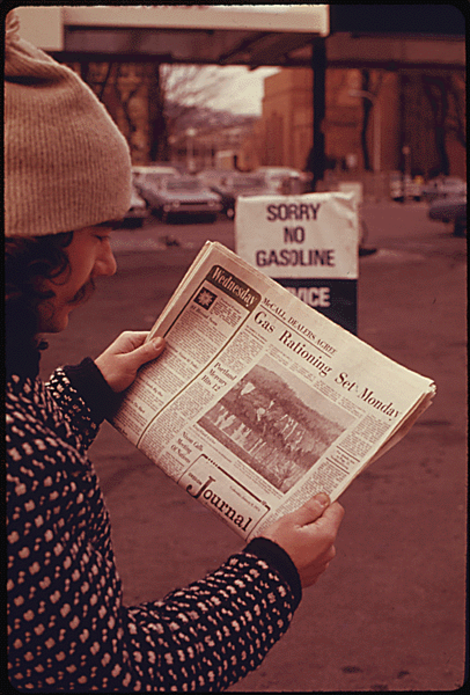
Have
American's forgotten the gas shortages and long lines at
their gas stations to get
gas during the Arab Oil Embargo of 1973?
"Apparently so." Mr. Goodell states that "in 1973, America was 'addicted' and 'over the barrel' of foreign oil to the amount of 40%. Forty percent of our energy 'needs' in 1973 came from countries - many of which didn't like us then, and I'm afraid, many of them still don't. The difference between 1973 and today - is that today we receive 50% MORE foreign oil now than we did in 1973. And now we know about the problems relating to greenhouse gas emissions that we didn't know then. America needs to change course, and change course now, in terms of its' energy supplies and how we keep America's economy strong, without the threat of being held hostage to a middle-east tyrant or regime, that could once again, turn on us, and turn off our supply of foreign oil."
Remember ????

"Sadly,
most Americans have forgotten the long lines of people waiting in their cars
- lined up and waiting
for gasoline at their nearby gas station, with lines that were many blocks
long. And, after waiting 4-5 hours, many even waiting overnight in many places, to
finally take their turn to fill up their car with gasoline, only to find that
the gas station
had run out of gas."
"Let me Repeat.... That was 1973 when we imported 40% of our daily energy requirements in the form of crude oil from overseas, and from foreign countries - and many of these from countries that don't like us.
Today, over 35 years later, America has yet to learn the lesson. We cannot continue our reliance on energy from foreign countries that supply us with 60% of the crude oil that our refineries use as a feedstock for producing gasoline and diesel fuel for our cars and trucks comes from overseas.
America is "over the barrel" and it's not our barrel, but the barrels of oil that we are addicted by and owned by other countries. Why have we not learned the lessons we needed to learn in 1973 when we were cut-off from the vital energy supplies we need?
Countries like China, are growing rapidly, and have an insatiable need for crude oil. China, with their booming economy, is increasingly growing in its clout and control over international supplies of crude oil - whether they do this through their ability to buy as much oil as they need on a daily basis, or whether they simply but American drilling rigs, technology, and explore and produce oil and gas from their own fields. China, is buying large amounts of oil for their country, and causing upward pricing on declining supplies. What happens if Russia, with all of their oil and natural gas, along with China and Venezuela, with or without the help of OPEC, decided to NOT sell oil to us????
To be sure, greenhouse gas emissions are a problem, and to some, greenhouse gas emissions are also a Clear and Present Danger, but not to the extent that it presents an imminent Clear and Present Danger.
America's reliance for 60% of our energy "needs" coming from foreign suppliers is un-acceptable.
The "driver" to get America to begin reducing and eliminating fossil fuel use should be our nation's national security and the welfare and safety of its citizens. And this can all begin with developing and investing in our own renewable energy resources and renewable energy technologies, let's start by putting solar on every rooftop that has a clear and unobstructed view of the Southern sky. See www.RooftopPV.com or www.DistributedPV.com for more information. Let's create incentives begin with adopting a national "Feed In Tariff" as Germany did in 1990.
We simply do NOT have the luxury of time on our hands. We need to end our
dependence and reliance on foreign fossil fuels, especially from countries that
don't like us! We need to rapidly begin expanding renewable
energy technologies from our vast and abundant renewable energy resources,
such as; solar, solar energy
systems, solar cogeneration,
solar trigeneration,
"solar on every roof," along with; Biomass
Gasification, B100 Biodiesel, Biomethane,
E100
Ethanol (from cellulosic, agricultural waste, sugar cane, etc., and NOT from
corn), Geothermal Power Plants,
Natural Wastewater Treatment,
Synthesis Gas, Waste
To Energy, Waste To Fuel and Wind
Power Generation where it makes economic and environmental sense."

marketing@UtilitySolarPower.com
We
support the Renewable Energy
Institute and the American
Energy Plan by donating a portion of our profits to the
Renewable Energy
Institute. The time has come for America to become energy
independent and to begin the transition away from fossil fuels
by increasing the amount of clean,
renewable energy in the USA. Renewable energy generates no; Carbon Emissions,
Carbon Dioxide Emissions,
Greenhouse Gas Emissions
or Hazardous
Air Pollutants.
Increased renewable energy production in the U.S. generates new American jobs
while decreasing our dependence on foreign oil. With oil at $100/barrel,
America spends 1/2 Trillion dollars every year buying foreign oil.
The Renewable Energy Institute is "Changing The Way The World Makes and Uses Energy by Providing Research & Development, Funding and Resources That Creates Sustainable Energy via 'Carbon Free Energy,' 'Clean Power Generation' and 'Pollution Free Power' Through Expanding the use of Renewable Energy Technologies."
Follow us on
Twitter:
Follow @UtilityScale


Renewable Energy Institute
"Changing the Way the
World Makes and Uses Energy"
www.RenewableEnergyInstitute.org
The information contained on this site is
copyright protected and
cannot be
reproduced in any form or manner without our consent.
Utility Solar Power
www.UtilitySolarPower.com
marketing@UtilitySolarPower.com
Renewable Energy Institute
Copyright
© 2009
All Rights Reserved